The peaks.
Most people tell their career as a list of jobs. I think of mine as a mountain range -- six peaks, each one shaped by the valley that came before it. This is that story.
PEAK I
The Stage
~1994 -- 2005
I went to NYU to study dance and architecture. Not dance or architecture -- both, at the same time. Tisch and the architecture school, simultaneously. That sounds like indecision, but it was actually the first version of the pattern that would define everything after: the body in space, and the structure around it. Those aren't different disciplines. They're the same discipline from two angles.
After NYU, I danced with Ballet Hispanico and performed on Broadway. Ten years of live performance -- the kind where the audience breathes with you and you know instantly whether it's working. No analytics dashboard. No A/B test. Just a room full of humans and the immediate feedback loop of their attention.
What stayed with me: the discipline of rehearsal, the ability to read a room, and the understanding that creative work is performed, not just produced. You don't ship it and walk away. You put it on its feet.
Key moments
- NYU Tisch School of the Arts + architecture program (simultaneous enrollment)
- Ballet Hispanico
- Broadway performances
I didn't climb down from the stage to find the camera -- I picked it up mid-show. Ten years of reading live audiences had built an internal meter for when a story lands. The camera took the audience away and handed me the edit instead: construct the story frame by frame, in silence, and trust the meter you built on stage.
PEAK II
The Film Camera
2000 -- 2005 (overlapping the Broadway years)
Film didn't come after the stage -- it grew alongside it. From 2000 to 2005, while I was employed on a Broadway show, I used every hour the run didn't own to build a complete filmmaking practice from scratch: writing, shooting, lighting, directing, editing, producing. Self-taught, deliberately. Looking back, that was Sageworx's first chapter -- see the next capability coming and build it yourself, before anyone asks you to.
The era put me on both sides of the camera. I performed in the film Chicago. I produced Living Treasures, a television series profiling people at or near 100 years old and asking what actually got them there. I wrote, directed, shot, edited, and produced Food For Thought, an independent film starring legendary Broadway performer Gregg Mitchell. And I produced Ice Cream Ants, Jeremy Carr's short horror film starring Marcus Ashley, Jill Tracy, and Tom Noonan -- SAG cast, a commissioned score, shot in Red Hook while I lived in New Jersey. It was Tom I drove to and from Manhattan every shoot day. Twenty-hour days. The hardest thing I'd ever done -- and the fastest education in what a story actually costs, because on an independent film there's no department you don't touch.
Film taught me to edit -- to craft the story bit by bit, scene by scene, for as long as it takes, and then output a finished thing. A dance is choreography in space; a film is choreography in time. And it's the stage inverted: no audience breathing with you, no meter running. You work in a vacuum, the way authors do, and find out at the end whether any of it lands.
What stayed with me: long-form story structure, the patience of the edit, production literacy from the ground up -- and my first hard lesson in feedback loops. Film doesn't give you one until it's over. That absence is its own discipline.
Key moments
- Chicago (feature film) -- on camera
- Living Treasures -- produced; TV series profiling centenarians and what got them there
- Food For Thought -- wrote, directed, shot, edited, produced; starring legendary Broadway performer Gregg Mitchell
- Ice Cream Ants -- produced; Jeremy Carr's short horror film starring Marcus Ashley, Jill Tracy, and Tom Noonan
- Built a full filmmaking practice self-taught: writing, shooting, lighting, directing, editing, producing
- Sageworx, chapter zero -- the build-the-capability-yourself pattern starts here
Independent film teaches you to make things with nothing. Broadcast teaches you to make things at scale -- standards, schedules, and an audience measured in millions. The hustle didn't change. The machine got bigger, and I wanted to know how every part of it worked.
PEAK III
Broadcast
2005 -- 2008
NBC Digital Studios in 2005 was a bet that broadcast networks needed to figure out the internet before the internet figured out broadcast. I arrived carrying film-production discipline into a network machine -- and got handed a frontier instead of a format.
We made original series for platforms that didn't have playbooks. We built content strategies for brands who didn't know they needed content strategies. We experimented constantly because there was nothing to optimize against -- no benchmarks, no case studies, no "best practices" deck to steal from. The feedback was overnight ratings and early click data -- delayed, aggregate, and mute about the why.
What stayed with me: the ability to build in uncertainty, to prototype instead of plan, and the conviction that the best creative work happens at the frontier -- before the frameworks show up and make everything predictable.
Key moments
- NBC Digital Studios -- original digital series inside a broadcast network
- Carrying film-production discipline into network scale
- Internet series + virals: The Easter Bunny Hates You, the What The Fight gaming series, and Kona & Hilo -- shot, directed, animated, and voiced (one of the cats), all inside Final Cut Pro 4
- Black20 -- founding team; first entertainment-focused venture, built in stealth for two years while at NBC Universal
Broadcast was reach without a feedback loop -- you shipped into the void and waited for ratings. Social flipped the equation. The audience talked back, in real time, and everything I'd learned on stage about reading a room suddenly applied to the entire internet. Build for the room you're actually in, not the room you wish you were in.
PEAK IV
The Social-First Era
~2005 -- 2015
Big Fuel was the on-ramp -- branded content and social strategy back when "social media agency" still sounded like a phase. Then 360i, one of those rare places where the work, the culture, and the timing all lined up.
I led production on Oscar Mayer and was part of the team that built the Oreo real-time model. Multiple Cannes Lions in a few years: The Great American Bacon Barter, Say It With Bacon, and Wake Up & Smell the Bacon all slayed -- and #Mamming became a genuine cultural moment. Follow Your NOLA proved branded content could be worth watching on its own merits, and the site -- built from great content shot by film directors all over that great city -- won a pile of awards for the experience it created in a web browser.
But the award count isn't the point. The point is that this era proved something: you could make creative work that was brand-funded, culturally relevant, and actually good -- all at the same time. Not good "for branded content." Just good. That was a new idea in 2012. It shouldn't still feel new in 2026, but here we are.
What stayed with me: the operating rhythm of real-time creative, the understanding that cultural relevance can't be planned six months in advance, and the knowledge that the best brand work happens when you stop thinking about what the brand wants to say and start thinking about what the audience already cares about.
Key moments
- The Great American Bacon Barter (Oscar Mayer) -- Cannes Lion
- Say It With Bacon (Oscar Mayer) -- Cannes Lion
- Wake Up & Smell the Bacon (Oscar Mayer) -- Cannes Lion
- #Mamming -- pro-bono viral cultural moment
- Follow Your NOLA -- branded content series and website build
- Oreo Daily Twist + Super Bowl Blackout -- real-time creative at scale
- Multiple Cannes Lions, Webbys, and industry recognition
Social-first proved I could lead creative + production that moves at culture speed -- small teams, fast decisions, real-time execution. But leading campaigns is different from building the infrastructure that makes campaigns possible. The next question wasn't "Can I make great work?" It was "Can I build the machine that makes great work repeatable?" That question turned into four studio builds.
PEAK V
The Studio Years
2015 -- 2019
This is the big-agency era -- traditional big-idea production at full throttle. Network television, Super Bowl-scale spots, the most polished end of the craft, with all the budget and machinery that implies. Advertising is where I learned to build the machine -- and where the feedback loop went from instinct to instrumentation. For the first time we had metrics on specific moments inside a video: the second a creative element stopped earning attention, the frame where people didn't just drift but clicked away. Immediate, granular, unforgiving -- and it changed every craft decision upstream of it.
I went deeper into production than I'd ever been. And then I stopped just running productions and started building the studios that run them.
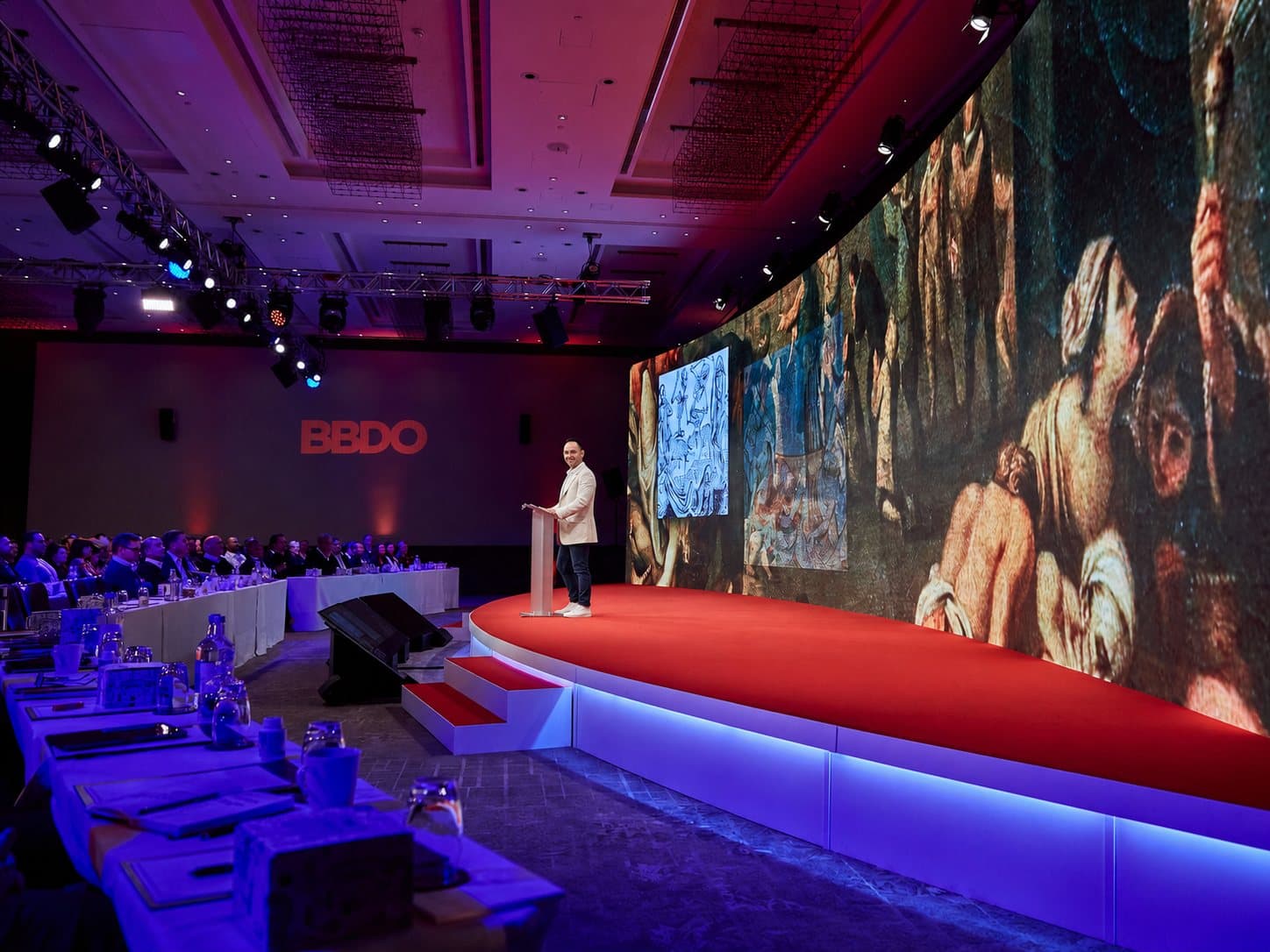
The first build happened inside 360i -- the production studio that made the social-first work possible. Then three more in four years, each inside a different kind of organization. Viacom's content studio was a media company trying to think like an agency. R/GA's content studio was a consultancy trying to think like a production company. BBDO Atlanta was a traditional agency trying to build a modern production arm.
Different parent companies, different client bases, different team DNA. But the core problem was always the same: how do you build a creative production engine inside an organization that wasn't designed for one? How do you staff it, scope it, price it, and protect it from the immune system of the larger organization that wants to absorb it back into the existing workflow?
I learned more about organizational design in those years than in the previous twenty. And I learned the hard way that the holding-company model adds weight without adding value. The studio works. The structure around it doesn't.
What stayed with me: how to build teams from scratch, how to design workflows that survive contact with real clients, and the conviction that the organizational model matters more than the creative talent inside it. You can have the best people in the industry, but if the org chart works against them, the work will be mediocre.

Key moments
- 360i production studio -- the first build
- Viacom Content Studio -- built from scratch
- R/GA Content Studio -- built and scaled
- BBDO Atlanta -- production infrastructure build-out
- Super Bowl spots -- McCormick, Jet.com, Verizon
- Learning organizational design through repeated practice
Studio builds taught me that the model works -- creative production studios can make world-class work at fair economics. But they also taught me that the holding-company structure is the bottleneck. The overhead, the politics, the six layers of approval, the reflexive underpricing. Sageworx took everything I'd learned about building creative production teams and rebuilt it without the weight. Independent. Distributed. Curated. And then AI showed up and changed the math on everything.
PEAK VI
Sageworx
2019 -- Now
Sageworx started as the answer to a simple question: what if you built a creative production company with none of the structural overhead that makes agencies expensive and slow?
The model is curation, not collection. We don't warehouse talent -- we curate it. 120+ senior creatives across four continents: strategists, directors, designers, producers, editors, developers, writers. Assembled per problem -- the right eight people for this brief, not the available eighty.
And we're AI-forward -- deliberately not "AI-native." Nobody's AI-native yet, except maybe the generation coming up behind us. Native implies the tools are the identity. Forward means the practice moves with them: AI as infrastructure wherever it multiplies the work, human judgment as the product everywhere it counts. And the feedback loop -- the thing every peak taught me to read -- is collapsing into the making itself. You can pressure-test the edit while you're still editing. The tools change monthly. The taste doesn't.
Today that looks like PDA partnerships, AI-forward film work, and the projects traditional agencies aren't structured to handle. This is the current peak. I don't know what the next one is. That's usually how it works.

Key moments
- Founded Sageworx (2019)
- Curated to 120+ members across four continents
- AI-forward operating model -- infrastructure, not decoration
- PDA partnership model
- AI-forward film production
The next peak.
I don't know what the sixth peak looks like. I never have. The stage didn't know it was preparing me for digital. Digital didn't know it was preparing me for social. Social didn't know it was preparing me for building studios. The studios didn't know they were preparing me for Sageworx.
What I know is that the valleys are where the learning happens. The space between peaks is where you figure out which skills transfer and which ones you need to let go. That's the thesis of the book, and it's the thesis of how I try to run Sageworx: build the team for the next peak, not the current one.